What Happens If I Have Nothing for Bailiffs to Take? The Complete Guide to Your Rights and Next Steps
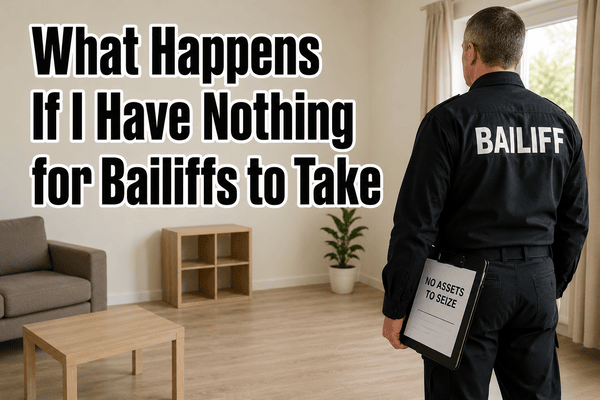
Many people facing debt enforcement worry about what bailiffs can do when they visit a property. One of the most common questions is, what happens if I have nothing for bailiffs to take? This concern often arises when someone has very few possessions, rents their home, or owns only essential household items.
The good news is that bailiffs cannot simply take anything they want. They must follow strict legal rules, and many everyday items are protected. Understanding your rights can help reduce uncertainty and allow you to make informed decisions when dealing with debt collection.
In this guide, we explain what happens when bailiffs visit a home with no valuable assets, what they can and cannot take, and what steps may follow.
Quick Info About What Happens If I Have Nothing for Bailiffs to Take
| Topic | Information |
|---|---|
| Can bailiffs take essential items? | No, essential household items are usually protected. |
| Will the debt disappear? | No, the debt remains outstanding. |
| Can bailiffs take items belonging to others? | No, they can only take goods owned by the debtor. |
| What if there are no valuable assets? | Bailiffs may leave without removing goods. |
| Can creditors continue collection efforts? | Yes, creditors may seek other legal recovery methods. |
| Is renting a home relevant? | Yes, renters often have fewer assets available for seizure. |
Understanding the Role of Bailiffs
Bailiffs are enforcement agents authorized to recover unpaid debts. They may be instructed to collect money owed for various types of debt, including court judgments, council tax arrears, parking penalties, and certain other financial obligations.
Their primary objective is to recover the debt either through payment arrangements or by taking control of goods that may be sold to help repay the amount owed.
However, their powers are not unlimited. They must comply with legal regulations and respect protected property rights.
What Happens If I Have Nothing for Bailiffs to Take?
If you genuinely own no valuable goods that can legally be seized, bailiffs may be unable to remove any property from your home.
In this situation, they typically record that there are insufficient goods available to satisfy the debt. Their report is then passed to the creditor or organization that instructed them.
The debt itself does not disappear. Instead, the creditor may decide how to proceed based on the circumstances of the case.
Bailiffs Cannot Take What Does Not Exist
A common misconception is that bailiffs will always leave with possessions. In reality, if there are no eligible assets available, they cannot seize property simply to meet a target.
If all belongings are exempt, low-value, or belong to another person, the bailiff may leave without taking anything.
The Debt Still Remains
Even when no goods are removed, the outstanding balance usually remains unpaid. Creditors may continue seeking repayment through legal channels that apply to the specific debt.
What Items Are Usually Protected?
Many people assume every item inside a property can be taken. This is not true.
Certain goods are generally protected because they are considered necessary for daily living.
Essential Household Items
Protected items often include:
- Beds and bedding
- Clothing
- Refrigerators
- Washing machines
- Cookers
- Dining furniture
- Basic household appliances
These items are generally regarded as necessities and cannot normally be removed.
Work-Related Equipment
Items required for employment or running a business may also receive protection.
Examples include:
- Work tools
- Professional equipment
- Trade-related machinery
- Essential business devices
The purpose of this protection is to allow individuals to continue earning an income.
Property Owned by Other People
Bailiffs can only take goods that belong to the debtor.
If an item belongs to a spouse, family member, friend, or landlord, it should not be seized. Proof of ownership may be helpful if ownership is disputed.
Why Some Homes Have Nothing Worth Taking
There are many reasons why a bailiff may find no recoverable assets.
Limited Personal Property
Some individuals own only basic household items that fall within protected categories.
Renting Instead of Owning
People who rent accommodation often own fewer high-value possessions compared to homeowners.
Financial Hardship
Long-term financial difficulties may leave someone with little or no valuable property available for enforcement purposes.
Shared Living Arrangements
In shared accommodation, many items may belong to other residents rather than the person who owes the debt.
What Bailiffs Usually Do Next
When there are no goods available for seizure, bailiffs generally report the outcome to the creditor.
Case Review
The creditor reviews the enforcement report and determines the next course of action.
Further Communication
The debtor may receive additional letters or requests regarding repayment options.
Alternative Recovery Methods
Depending on the nature of the debt and legal circumstances, creditors may explore other lawful methods of recovery.
The exact options available vary significantly between different types of debts.
How to Deal with a Bailiff Visit
Knowing how to respond can make the process less stressful.
Stay Calm
Remain polite and cooperative. Aggressive behavior can complicate the situation unnecessarily.
Verify Identification
Always ask to see identification and documentation confirming the purpose of the visit.
Understand Your Rights
Knowing what bailiffs can and cannot do helps prevent misunderstandings.
Keep Records
Maintain copies of letters, notices, and any communication related to the debt.
Common Myths About Bailiffs
Many myths create unnecessary fear for people facing debt issues.
Myth 1 – Bailiffs Can Take Everything
False. Numerous items are legally protected.
Myth 2 – Bailiffs Can Take Other People’s Property
False. Bailiffs can generally only take goods owned by the debtor.
Myth 3 – No Assets Means the Debt Is Gone
False. The debt remains outstanding even if nothing is removed.
Myth 4 – Bailiffs Always Enter Homes
False. Entry rights depend on the circumstances and type of debt involved.
Protecting Yourself During Debt Difficulties
If you are struggling financially, taking action early is often the best approach.
Open communication, understanding your obligations, and seeking reliable debt advice can help prevent situations from becoming more complicated.
Ignoring correspondence rarely solves financial problems. Addressing issues early may provide more options and reduce stress.
Conclusion
If you are asking, what happens if I have nothing for bailiffs to take, the simple answer is that bailiffs cannot remove property that does not exist or cannot legally be seized. If there are no eligible assets available, they may leave without taking any goods. However, the debt itself usually remains outstanding, and the creditor may decide to pursue other recovery options.
Understanding your rights, knowing which items are protected, and responding appropriately to enforcement action can help you navigate the situation with greater confidence and clarity.
FAQs About What Happens If I Have Nothing for Bailiffs to Take
Can bailiffs take my bed or clothes?
No. Essential household items such as beds and clothing are generally protected.
Will my debt be written off if bailiffs find nothing?
No. The debt usually remains outstanding even if no goods are seized.
Can bailiffs take items owned by my family?
No. Bailiffs should only take goods that belong to the debtor.
What happens if all my belongings are exempt?
The bailiff may be unable to remove any items and may report this to the creditor.
Can bailiffs enter every room in my home?
Their powers depend on the circumstances and the type of debt involved.
Should I ignore bailiff letters?
Ignoring correspondence is generally not advisable. Understanding the situation and responding appropriately is usually the better approach.