Ofsted report card concerns: Why Schools, Parents, and Leaders Are Still Debating the New Inspection System
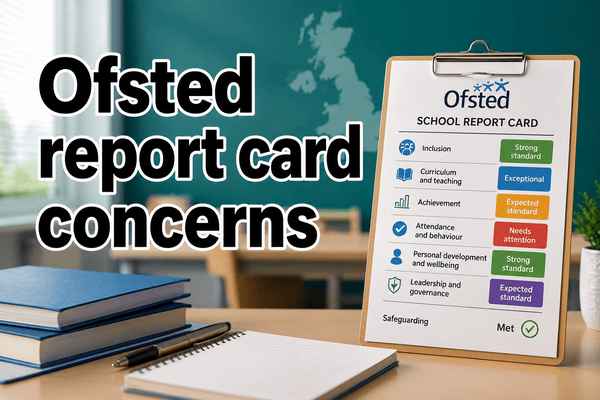
Ofsted report card concerns have become a major topic in England’s education sector because the inspection system has moved away from a single overall judgement and now uses a more detailed report card model. The change was introduced to give parents a clearer picture of how schools perform across different areas, rather than reducing a school’s quality to one word.
Under the new system, schools are judged through separate areas such as inclusion, curriculum and teaching, achievement, attendance and behaviour, personal development and wellbeing, and leadership and governance. Safeguarding is judged separately as either “met” or “not met.” The five report card grades are “Exceptional,” “Strong standard,” “Expected standard,” “Needs attention,” and “Urgent improvement.”
On paper, this looks more balanced. However, many school leaders and education unions argue that the new model may create fresh pressure instead of solving the problems linked to older Ofsted inspections.
Why the New Ofsted Report Cards Were Introduced
Moving Away From One-Word Judgements
The old Ofsted system was often criticised because a single judgement could shape public opinion about a school. A school labelled “Outstanding” or “Inadequate” could be viewed through that one term, even if its actual performance was more complex.
The report card model tries to show strengths and weaknesses separately. For example, a school may be strong in curriculum but need attention in attendance. This gives parents more detail and may help schools focus improvement work more precisely.
A More Detailed Picture for Parents
The main purpose of the new system is to provide clearer information for parents and carers. Instead of reading one headline grade, families can now see how a school performs across several important areas. This can support better decision-making, especially when parents are comparing schools.
However, this is also where concerns begin. A more detailed system can be useful, but it can also become harder to understand if too many grades are presented at once.
Main Ofsted Report Card Concerns
Increased Pressure on School Leaders
One of the strongest concerns is that report cards may increase pressure on headteachers and senior leaders. Although the single overall grade has been removed, schools now receive multiple graded judgements. This means there are more areas where a school can be publicly marked down.
Education unions have argued that this could continue the high-stakes culture of inspection. A school may no longer be defined by one word, but one weak judgement in a key area could still affect reputation, staff morale, and parental confidence.
Why This Matters for Staff Wellbeing
Inspection pressure is not just an administrative issue. It affects workload, confidence, and mental health across the school workforce. Leaders may feel they must constantly prepare evidence for every inspection area. Teachers may also experience additional pressure if the school is trying to avoid a lower grade in curriculum, behaviour, achievement, or inclusion.
Concern About Too Many Judgement Areas
Another concern is the number of separate areas being judged. Supporters say this gives a fuller picture. Critics say it creates a heavier inspection burden.
When schools are judged across several categories, leaders must ensure that each area is inspection-ready. This can shift attention away from long-term educational improvement and toward documentation, compliance, and presentation.
The Risk of Inspection Becoming More Complex
A detailed report card can help parents, but only if the information is easy to understand. If the system becomes too technical, parents may still look for the lowest or highest grade rather than reading the full report. This could recreate the same problem as the old single-word judgement, only in a different form.
Concern About the Five-Point Scale
The five-point grading scale is another major issue. Ofsted has made clear that the new grades should not be directly compared with old grades. For example, “Exceptional” is not simply the same as “Outstanding,” and “Needs attention” is not exactly the same as “Requires improvement.”
This distinction matters because many parents, media outlets, and local communities may still try to compare old and new grades. Misinterpretation could create confusion, especially during the early years of the new system.
Concern About Consultation and Implementation
NAHT challenged the reforms legally, raising concerns about consultation and the five-point scale. Although the High Court refused permission for the judicial review, the challenge showed the level of concern among school leaders.
Some unions also argued that schools needed more time to understand and prepare for the new framework. A major reform to inspection affects leadership planning, staff training, governance, communication with parents, and school improvement priorities. For this reason, rushed implementation has been a repeated concern.
Ofsted’s Position on Report Cards
More Nuance and Less Simplification
Ofsted argues that report cards are fairer because they avoid reducing a school to one headline judgement. The new model is designed to show what a school does well and where improvement is needed.
This is a reasonable aim. Schools are complex institutions. A single grade can miss important details. A report card can show that a school may be doing strong work in some areas while still needing support in others.
Supporting Improvement
Ofsted also presents the new framework as a tool for improvement. By identifying specific areas of strength and weakness, schools should be able to plan more targeted action. Parents may also gain a better understanding of the school’s priorities.
The success of this approach depends on how the system is used. If report cards are used constructively, they may support improvement. If they become another high-pressure ranking tool, many of the old problems may remain.
Quick Info & FAQs About Ofsted Report Card Concerns
What Are Ofsted Report Cards?
Ofsted report cards are the new inspection reports used to show how schools perform across several separate areas. They replace the old single overall judgement.
What Grades Are Used?
The grades are Exceptional, Strong standard, Expected standard, Needs attention, and Urgent improvement. Safeguarding is judged separately as met or not met.
Why Are People Concerned?
The main concerns are increased pressure, more judgement areas, possible confusion over grades, and questions about whether the system genuinely reduces inspection stress.
Are New Grades the Same as Old Ofsted Ratings?
No. Ofsted has stated that the new grades should not be directly compared with the old system.
Why Do Some Unions Oppose the Changes?
Unions have raised concerns about staff wellbeing, high-stakes accountability, consultation, workload, and the possible impact of multiple graded areas.
Do Report Cards Help Parents?
They may help parents by giving more detail. However, the benefit depends on whether parents can easily understand the grades and read the full inspection context.
Final Thoughts
Ofsted report card concerns are not only about the report card format itself. They are about trust, fairness, workload, staff wellbeing, and how school quality should be judged. The new system offers more detail than the old single-word judgement, which is a positive step. However, concerns remain that multiple grades may still create pressure and may even make inspection feel more demanding.